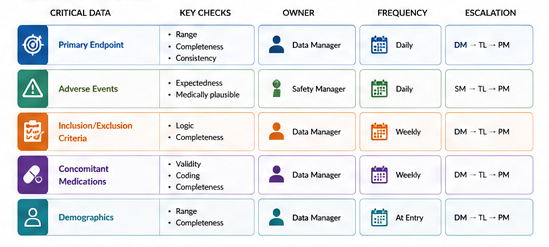
A data quality plan describes how the study will prevent, detect, manage, and report quality problems. It may be a standalone document or part of the broader data management plan.
The plan should be prepared before data collection begins and should be reviewed whenever the protocol, database, or workflow changes.
The plan should identify critical data and critical processes. Critical data are data that affect participant safety, primary and secondary outcomes, eligibility, informed consent, regulatory reporting, or key analysis variables. Critical processes are study processes that, if performed poorly, could compromise participant protection or data reliability. Examples include consent documentation, randomization, adverse event reporting, laboratory result transfer, and primary outcome assessment.
The plan should define the checks to be performed. These may include missing form reports, range checks, date logic checks, duplicate checks, cross-form consistency checks, adverse event reconciliation, laboratory reconciliation, query aging reports, audit trail review, and site performance dashboards. Each check should have an owner, frequency, expected action, and escalation pathway.
Frequency should be risk-based. Some checks may run daily, such as serious adverse event review or safety dashboard monitoring. Others may run weekly, such as missing forms, entry lag, and open queries. Some may run monthly, such as site trend reviews or audit trail sampling. The plan should also specify what happens when problems are detected. Who raises queries? Who responds? When are unresolved issues escalated? How are repeated problems handled?
Data quality planning is not only technical. It requires collaboration with investigators, coordinators, monitors, and statisticians. The statistician may identify variables that require special cleaning rules. Coordinators may identify workflow constraints. Monitors may identify source verification priorities. Investigators may decide clinical plausibility rules. The data manager integrates these perspectives into a practical quality plan.
| Component | Example content |
|---|---|
| Critical data | Consent, eligibility, primary outcome, adverse events, key covariates |
| Quality checks | Missing data, range, logic, duplicates, query aging, entry lag |
| Frequency | Daily safety checks, weekly missing data review, monthly site trends |
| Responsible person | Data manager, site coordinator, monitor, statistician |
| Tools | REDCap Data Quality module, reports, R scripts, dashboards |
| Query workflow | Query creation, site response, review, closure |
| Escalation | Open critical queries older than seven days escalated to PI |
| Documentation | Quality logs, query metrics, meeting minutes, change logs |