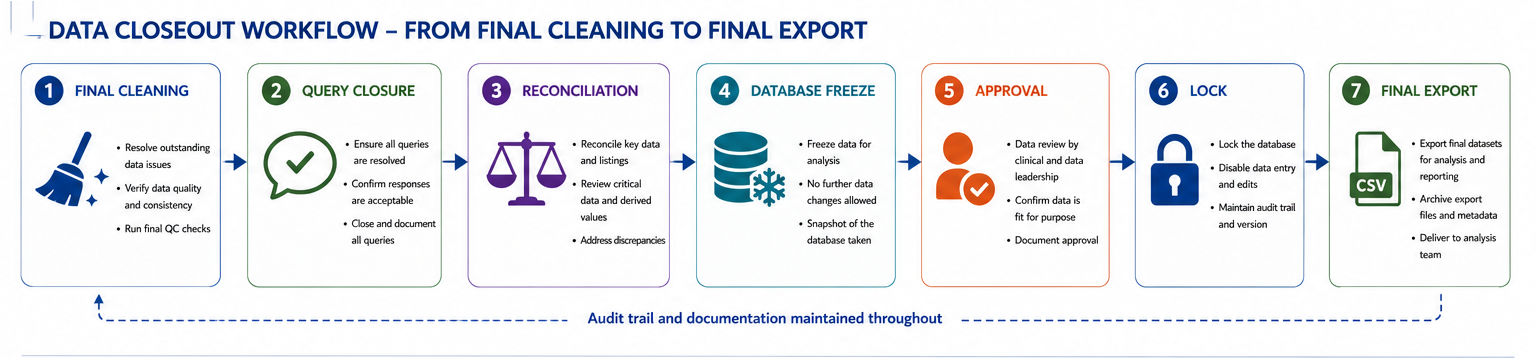
Database freeze and database lock are important milestones near the end of a study or analysis period. The terms may vary by institution, but generally a database freeze is a temporary restriction or snapshot used to support review, interim analysis, or final cleaning. Database lock is the formal point at which data are considered final for analysis and no further changes should occur without a controlled unlock process.
Before database freeze, the data manager should ensure that expected data are present, key checks have been run, major discrepancies have been queried, and outstanding issues are documented. A freeze may be used to allow statisticians to prepare preliminary analysis while final queries are resolved. It should be clear which dataset version is frozen, when it was exported, what exclusions or unresolved issues remain, and who approved the freeze.
Before database lock, the requirements are stricter. All critical queries should be resolved or documented. Primary outcome data should be complete or missingness explained. External data should be reconciled. Serious adverse events should be reconciled with safety databases or logs. Protocol deviations should be reviewed. Coding should be finalized. Audit trail concerns should be addressed. The data dictionary and metadata should be complete.
The statistician should confirm that the dataset is ready for final analysis.
Lock should be a controlled decision involving the data manager, principal investigator, statistician, monitor or sponsor where applicable, and sometimes quality assurance. The lock decision should be documented. After lock, changes should be rare and should require formal approval, documentation of reason, database unlock, correction, relock, and version update.
This protects the credibility of final analyses. Database lock is not only a technical action. It is a declaration that the study team has completed required data management activities and that the dataset is fit for final analysis. A rushed lock can lead to analysis delays, rework, and credibility concerns. A well-planned lock reflects continuous quality management throughout the study.
| Area | Readiness question |
|---|---|
| Completeness | Are expected forms and critical variables complete or explained? |
| Queries | Are critical queries closed or documented? |
| Outcomes | Are primary and secondary outcomes reviewed? |
| Safety | Are adverse events and serious adverse events reconciled? |
| External data | Are laboratory and other external datasets reconciled? |
| Duplicates | Have duplicate participants or records been resolved? |
| Coding | Are categorical codes and derived variables finalized? |
| Audit trail | Have critical late changes and deletions been reviewed? |
| Documentation | Are data dictionary, metadata, and cleaning logs complete? |
| Approval | Have PI, data manager, and statistician approved lock? |