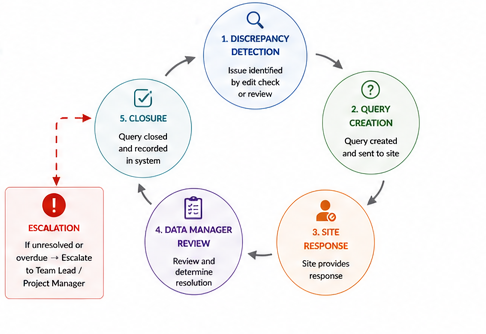
A query is a request for clarification or correction of a data issue. Queries are used when data are missing, invalid, inconsistent, unclear, unsupported by source documents, or otherwise questionable. Query management is the structured process through which discrepancies are identified, communicated, responded to, reviewed, and closed.
The query workflow usually begins with discrepancy detection. A discrepancy may be identified by a validation rule, REDCap report, monitor, data manager, statistician, or automated R script. The data manager or monitor reviews the discrepancy to determine whether a query is needed. Not every unusual value requires correction. Some values are unusual but true. The query should ask the site to verify or clarify the value against source documentation.
After a query is raised, the site reviews the source document and responds. The response may correct the database value, confirm that the current value is correct, provide an explanation, or indicate that the data are unavailable. The data manager then reviews the response. If the response resolves the issue, the query is closed. If the response is incomplete or creates a new concern, the query may be returned for further clarification.
Queries should be tracked. The system or query log should record query date, variable, participant, issue, responsible site, response, closure date, and status. This allows the team to monitor query volume, aging, resolution time, recurring problems, and site performance. Query tracking is also important for database lock because all critical queries should be resolved or documented before finalization.
The query workflow should be respectful and collaborative. Queries are not accusations.
They are quality tools. Poorly written or excessive queries can frustrate site staff and slow study operations. Clear, relevant, and prioritized queries help sites understand what needs attention and why it matters.
| Status | Meaning |
|---|---|
| Open | Query has been raised and awaits site response |
| Answered | Site has responded but response requires review |
| Returned | Response did not resolve the issue and query was sent back |
| Closed | Issue has been resolved or adequately documented |
| Canceled | Query was raised in error or no longer applies |
| Escalated | Query requires investigator, monitor, or management attention |