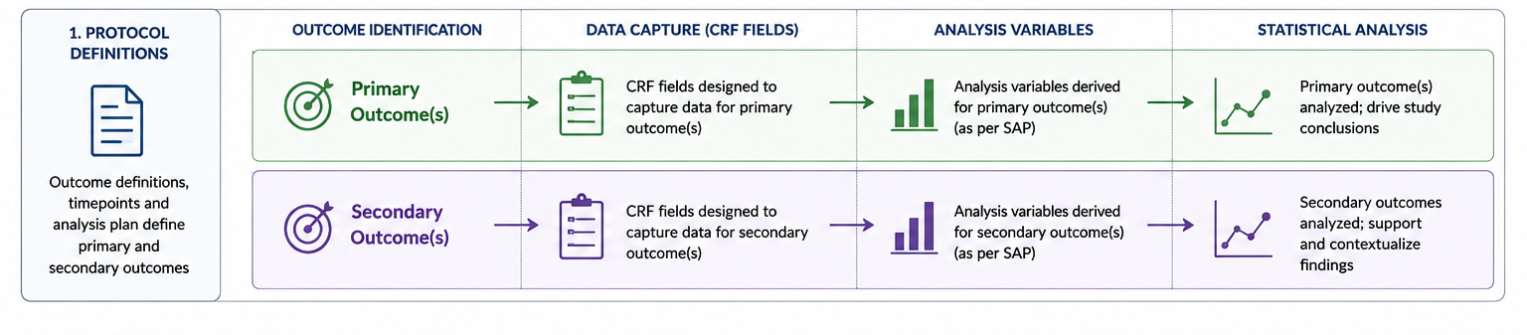
Outcomes are measurements used to evaluate the questions posed by a study. They are central to protocol translation because they determine what the study ultimately needs to measure. The primary outcome is the main outcome used to answer the principal research question.
Secondary outcomes provide additional information about safety, mechanisms, feasibility, acceptability, clinical effects, or supporting evidence. In a clinical trial, the primary outcome might be treatment success at day, mortality by hospital discharge, viral suppression at six months, or fever clearance within 48 hours. Secondary outcomes might include adverse events, length of hospital stay, adherence, quality of life, laboratory changes, cost, or patient satisfaction. In an observational cohort, the primary outcome might be incidence of infection, retention in care, disease progression, or time to event. The exact outcome depends on the study design and scientific question.
Primary outcomes require particular care because they drive sample size calculations, analysis plans, interpretation, and often regulatory or policy conclusions. A primary outcome should be defined with enough precision that different study staff at different sites can collect it consistently. The CRF should capture not only the outcome status but also the information needed to determine whether the outcome occurred according to the protocol definition.
For example, if the primary outcome is “fever resolution within 48 hours,” the CRF must define fever, specify how temperature is measured, state the unit of measurement, record the assessment time, and capture whether antipyretic medication or missing visits affect interpretation. If the study simply asks “Was fever resolved?” without recording measured temperature and time, the result may depend on staff judgment rather than standardized measurement.
Secondary outcomes also require structured design. They may not drive the main conclusion, but they often provide important context. In safety-focused studies, adverse events maybe secondary outcomes but still require serious attention because they affect participant protection and reporting obligations. In implementation research, acceptability or feasibility outcomes may require survey instruments, qualitative notes, or operational indicators. These must be planned rather than improvised.
Outcome design should involve the statistician early. The statistician can advise whether a variable should be continuous, categorical, binary, ordinal, or time-to-event. They can identify covariates, stratification variables, and derived variables needed for analysis. The data manager then ensures that raw data are captured in a form that allows the statistician to derive the required analytical variables. A common mistake is to collect only a derived conclusion rather than the raw components needed to verify it.
| Question | Why it matters | Example |
|---|---|---|
| What is the outcome definition? | Ensures consistent classification | “Clinic attendance within 30 days” must define eligible visit types |
| When is the outcome assessed? | Aligns data collection with protocol timing | Day 7, day 28, six months, discharge |
| What is the source document? | Supports verification and audit | Clinic register, laboratory report, follow-up form |
| What format is required? | Supports analysis | Binary, date, numeric value, category, time-to-event |
| Are derived variables needed? | Guides raw variable capture | Days from discharge to attendance |
| How will missing outcomes be handled? | Prevents ambiguity in analysis | Lost to follow-up, refused, died, unable to contact |