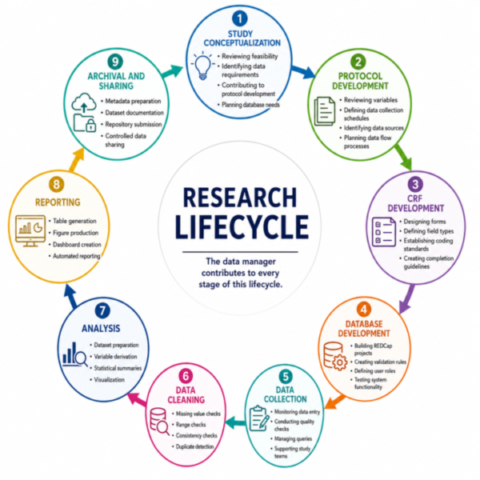
The clinical research lifecycle refers to the sequence of activities through which a study moves from an idea to completed outputs, archived records, and potentially reusable datasets. Al though studies differ in design, most follow a recognizable pattern: conceptualization, protocol development, ethics and regulatory approvals, tool design, database development, training, data collection, monitoring, cleaning, analysis, reporting, archival, and sharing. Data management activities occur at each stage.
During conceptualization, researchers identify a problem and formulate research questions. At this early stage, data managers can contribute by assessing whether the proposed data are feasible to collect, whether existing data sources are reliable, and whether the intended outcomes can be measured consistently. This is particularly important in clinical and public health settings where routine records may vary in completeness or where different sites may use different documentation practices.
During protocol development, the study design becomes more formal. The protocol defines objectives, endpoints, eligibility criteria, procedures, visit schedules, safety assessments, data sources, and analysis plans. A data manager reads the protocol not only as a scientific document but also as a data specification. Every procedure implies data. Every endpoint implies variables. Every visit schedule implies timing. Every eligibility criterion implies screening fields. Every safety requirement implies adverse event documentation.
During CRF and database development, the protocol is translated into structured data collection instruments. Case report forms and electronic instruments must be designed so that study staff can collect the required information clearly and consistently. REDCap projects or other electronic systems are then configured with field types, validation rules, branching logic, calculated fields, user roles, reports, and audit settings. This stage is where many future data quality problems are either prevented or accidentally built into the study.
During data collection, the data manager monitors completeness, timeliness, and consistency. Study teams may collect data from clinical assessments, laboratory results, participant interviews, medical records, mobile tools, or external systems. Data managers support users, review quality indicators, generate queries, maintain logs, and help ensure that data entered into the database are traceable to source documents.
During data cleaning and analysis preparation, the focus shifts toward producing an
analysis-ready dataset. Cleaning does not mean changing data arbitrarily. It means identifying and resolving errors according to documented procedures. The data manager may check missing values, out-of-range measurements, duplicate records, inconsistent dates, invalid codes protocol deviations, and unexpected patterns. In this course, learners will use R to design reproducible cleaning workflows so that transformations can be reviewed and repeated.
During reporting, archival, and sharing, data managers support the preparation of tables, dashboards, reports, data dictionaries, metadata, and final study files. They help ensure that datasets are preserved with enough documentation for future interpretation. Where data sharing is permitted, they support controlled access, de-identification, governance review, and compliance with consent and regulatory requirements.
Figure 1.2: Suggested diagram showing data management responsibilities mapped to each phase of the clinical research lifecycle