Clinical Research Data Management Course

Wishlist Share

About Course

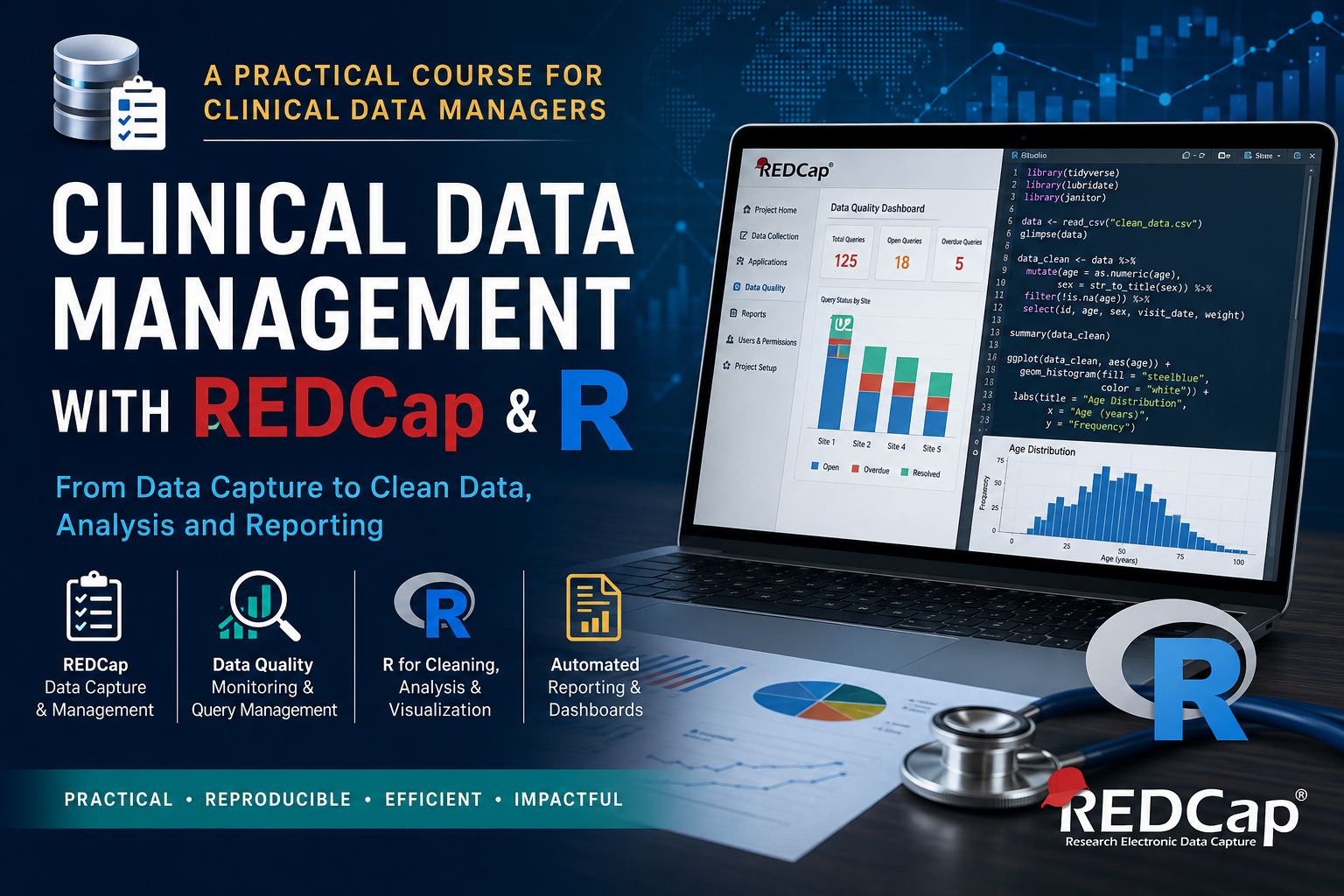
This 12-week instructor-led course provides practical, hands-on mentorship and training in clinical research data management using open-source tools. It teaches principles of data management and concepts of data science required to support clinical research projects. It focuses on the end-to-end data lifecycle – from protocol translation and CRF development to database design, validation, data quality control, monitoring, cleaning, visualizations, curation, analysis, report writing and data archival.

Participants will gain competencies in applying Good Clinical Practice (GCP), FAIR Data Principles, and Data Protection standards, with an emphasis on using REDCap for database design and R for data management and visualization.

By the end of the course, participants will be able to:

  • Design clinical databases in REDCap aligned with study protocols.
  • Develop data management plans and workflow documentation.
  • Conduct data validation, cleaning, and quality checks.
  • Analyze and visualize clinical data using R.
  • Generate automated reports and dashboards for study monitoring.

Apply ethical and regulatory frameworks for secure data handling.

Show More

What Will You Learn?

  • The Clinical Research Data Management Course provides a practical foundation for managing high-quality research data throughout the clinical research data lifecycle. It combines core data management principles with hands-on application of tools such as REDCap and R, helping learners understand not only how to manage data, but also why good data management is essential for credible and ethical research.
  • Understand the clinical research data lifecycle, from study planning and data collection through cleaning, analysis, reporting, archiving and close-out.
  • Apply principles of data governance, ethics, privacy, confidentiality and regulatory compliance.
  • Design effective data collection systems and electronic Case Report Forms (eCRFs).
  • Build and manage research databases using REDCap.
  • Use R for practical clinical data management, including importing, cleaning, transforming, validating and summarising datasets.
  • Create data visualisations and monitoring dashboards to support research oversight and decision-making.
  • Apply recognised Good Clinical Practice and clinical data management standards in day-to-day research activities.
  • The course places particular emphasis on practical application. Learners work with realistic clinical research scenarios and datasets rather than learning data management only as theory. The course also introduces the use of R and Shiny for monitoring and visualisation; for example, learners develop monitoring outputs covering enrolment, missing outcomes and open data queries.

Course Content

Foundations of Clinical Research Data Management
An introductory course covering how clinical research data is collected, managed, cleaned, and prepared for analysis while ensuring quality and regulatory compliance.

  • Welcome to this course
  • Introduction to clinical data management
  • The Evolution of Clinical Data Management
  • Why Data Management Matters.
  • The Clinical Research Lifecycle
  • The Role of the Clinical Data Manager
  • Key Characteristics of High-Quality Data
  • Data Flow in Clinical Research
  • Introduction to Good Clinical Practice
  • Introduction to FAIR Data Principles
  • Data Protection, Ethics, and Confidentiality
  • Chapter Summary
  • Quiz

Protocol Translation and Case Report Form (CRF) Design
Focuses on translating study protocols into structured data requirements and designing clear, accurate Case Report Forms (CRFs) that support efficient and compliant data collection.

Database Design in REDCap
The REDCap database design phase transforms well-designed CRFs into a functional electronic data capture system.

Data Entry, Validation, and Access Control
This chapter explores the operational aspects of data collection within REDCap, including data entry workflows, validation procedures, user rights management, audit trails, and quality assurance activities that help ensure research data remain reliable and compliant with regulatory standards.

Data Quality Management and Query Resolution
This topic is about ensuring that data is accurate, complete, and consistent. It covers identifying, investigating, and correcting errors or discrepancies in data. It also focuses on timely resolution of data queries to maintain data integrity and reliability.

Introduction to R for Clinical Data Management.
This topic introduces R, an open-source programming language used for statistical analysis, data management, and visualization. In clinical research, R is applied to clean, analyze, and report data in a reproducible and reliable manner.

Data Cleaning and Preparation in R
This topic introduces data cleaning and preparation in R, focusing on organizing and transforming raw data into a usable format. It covers handling missing values, correcting errors, and structuring data to ensure accurate and reliable analysis.

Data Analysis in R
This topic introduces data analysis in R, focusing on applying statistical methods to explore and interpret data. It covers summarizing data, performing analyses, and generating insights to support clinical research decisions.

Data Visualization and Dashboards
This topic is about presenting data in visual formats such as charts and graphs to make it easier to understand. It also covers creating dashboards that organize and display key information for effective monitoring and decision-making.

Reporting and Reproducibility
This topic is about generating clear and accurate reports from data analysis. It also focuses on ensuring that analyses can be consistently reproduced using well-documented methods and scripts.

Data Documentation and Metadata
This topic is about describing and organizing data through clear documentation and metadata. It focuses on defining data elements, structures, and context to ensure data is understandable, consistent, and usable.

Final Project Preparation, Presentation, and Course Integration
Focuses on preparing and organizing a final project using knowledge and skills gained throughout the course.

Student Ratings & Reviews

No Review Yet
No Review Yet

Want to receive push notifications for all major on-site activities?

✕